Melasma and post-inflammatory hyperpigmentation can both look like flat brown or grey patches, especially on Malaysian skin, but they do not behave in the same way. Treating “pigmentation” before identifying its pattern and trigger can waste time or make discoloration darker, particularly when heat, irritation or aggressive laser settings are involved.
What is the key difference?
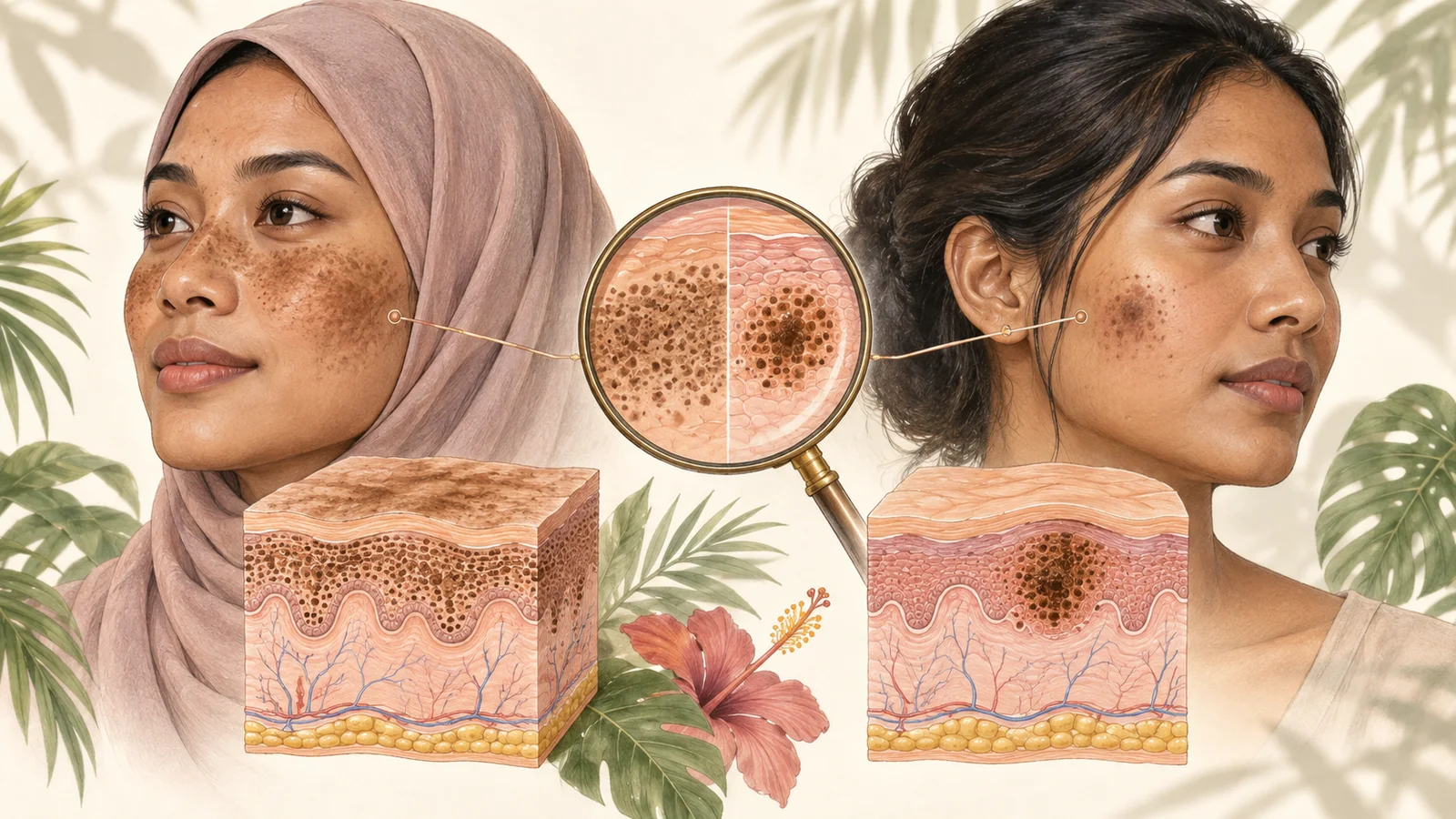
Melasma usually forms symmetrical patches on sun-exposed facial areas and is influenced by light, hormones, genetics and heat or irritation. Post-inflammatory hyperpigmentation, or PIH, appears where acne, eczema, injury, friction or a procedure caused inflammation. A person can have both conditions at once, which is why diagnosis matters before laser.
Melasma versus PIH at a glance
| Feature | Melasma | Post-inflammatory hyperpigmentation |
|---|---|---|
| Typical pattern | Often symmetrical patches on cheeks, forehead, upper lip or jawline | Follows the exact sites of acne, rash, injury, scratching or treatment |
| Main trigger | Ultraviolet and visible light, hormones, genetics and irritation | Inflammation or skin injury |
| Course | Chronic and prone to recurrence | May gradually fade once inflammation stops, but can persist |
| First priority | Daily light protection and pigment control | Stop the underlying inflammation and prevent new marks |
| Laser role | Selected resistant cases, usually as part of a combined plan | Often second-line after topical care, with careful parameters |
| Main procedure risk | Rebound, mottled pigment, PIH or loss of pigment | New inflammation causing darker PIH |
What does melasma look like?
Melasma commonly produces irregular light-brown, dark-brown or grey-brown patches. The centrofacial pattern involves the forehead, cheeks, nose, upper lip and chin. A malar pattern concentrates on the cheeks and nose, while a mandibular pattern affects the jawline. Colour and borders vary with pigment depth and skin tone.
The surface is usually smooth. Melasma itself does not normally cause scaling, pain or itch. If a patch is inflamed, thick, rapidly changing or symptomatic, another diagnosis may be present. Melasma can become more noticeable after sun exposure, pregnancy, hormonal medication or irritating skincare.
What does PIH look like?
PIH maps the history of inflammation. Acne marks follow previous pimples. Eczema leaves patches where the skin was red and itchy. Friction, insect bites, burns, hair removal, peels or laser can leave colour in the treated shape. The mark may be tan, brown, grey, blue-grey or nearly black depending on pigment depth and skin tone.
PIH is not a scar. A flat colour change differs from an indented acne scar or a raised keloid, although both can coexist. Treating pigment alone will not correct texture, and resurfacing intended for scars may worsen colour if inflammation is not controlled.
Why Malaysian skin needs a cautious plan
Many Malaysian patients have Fitzpatrick skin types III to V and tan readily. More epidermal melanin can absorb energy intended for a pigment target, narrowing the safety margin of some devices. Darker skin is also more prone to PIH after irritation. This does not mean laser is impossible, but device, wavelength, fluence, pulse, cooling and intervals matter.
Ethnicity alone does not determine treatment. Recent tanning, outdoor work, active acne, medication, previous reactions and the actual pigment depth may be more important. A careful clinician assesses the whole context instead of selecting settings from a skin-colour label.
Can one person have melasma and PIH?
Yes. A patient may have symmetrical melasma across the cheeks plus darker spots from acne. Aggressive treatment of acne can create more PIH, while heat and light can worsen melasma. A combined diagnosis explains why one area improves but another appears darker.
The plan may begin with gentle acne control, barrier repair and sunscreen before targeting residual pigment. Photographs taken under consistent lighting help separate change in broad melasma from change in individual acne marks.
How is the diagnosis made?
Diagnosis begins with history and examination. The clinician asks when the pigment appeared, whether it followed inflammation, pregnancy, hormones, medication, sun, a peel or a laser. They examine symmetry, border, colour, surface change and active skin disease.
A Wood’s lamp or dermatoscope may help assess pattern and pigment depth, though findings do not guarantee response. If the appearance is unusual, a biopsy or other investigation may be needed to exclude conditions that resemble melasma. Do not laser an uncertain dark lesion.
Conditions that can mimic “pigmentation”
- Lentigines or sun spots
- Drug-related pigmentation
- Lichen planus pigmentosus
- Ochronosis after prolonged inappropriate hydroquinone use
- Contact dermatitis with pigment change
- Hori naevi or other dermal melanocytosis
- Seborrhoeic keratosis
- Acanthosis nigricans
- Fungal or inflammatory rashes
- Changing moles and skin cancer
These conditions need different management. A device marketed for “all pigmentation” cannot replace clinical diagnosis.
Why laser can make pigment darker
Laser creates controlled energy in tissue. If that energy causes excessive inflammation, melanocytes can produce or release more pigment, creating PIH. This risk is higher with aggressive settings, overlapping passes, recent tanning, poor aftercare, active dermatitis and darker skin types.
Melasma also has a recurrent biological tendency. Even when pigment particles lighten, the underlying response to light and hormones remains. Repeated high-energy treatment can lead to rebound, uneven hypopigmentation or mottled colour. More sessions or more power are not automatically better.
Red flags before cosmetic laser
Delay treatment and obtain medical assessment if a patch is new and changing, raised, bleeding, ulcerated, painful, one-sided without explanation, or accompanied by systemic symptoms. Active infection, open skin, severe eczema, recent tanning, isotretinoin history, pregnancy and medications also need discussion before any procedure.
Is Pico laser always best for melasma?
Picosecond devices deliver very short pulses and can target pigment, but the word “Pico” does not guarantee a safe or permanent result. A 2026 meta-analysis of randomized trials found that picosecond alexandrite laser did not outperform all conventional approaches and PIH was more common than with topical creams in the pooled comparison.
Device wavelength, settings, operator experience and patient selection remain important. Laser is generally not first-line monotherapy for melasma. It may be considered for selected resistant cases alongside light protection and medical therapy after realistic counselling.
Why treatment should start with light protection
Ultraviolet light stimulates pigmentation, and visible light can worsen melasma, particularly in darker skin. The American Academy of Dermatology recommends broad-spectrum, water-resistant SPF 30 or higher and notes that tinted sunscreen containing iron oxide helps protect against visible light.
Apply an adequate amount to the face, ears and exposed neck and reapply during outdoor exposure, sweating or swimming. Hats, shade and avoiding peak exposure reduce the amount sunscreen must handle. A laser series without daily protection is unlikely to produce stable value.
Skincare before procedures
Use a gentle cleanser, moisturizer and sunscreen. Products that burn or sting can inflame skin and darken marks. Introduce one active product at a time. Scrubs, strong acids, essential oils and multiple brightening serums can create irritant dermatitis that looks like treatment failure.
A clinician may prescribe hydroquinone, azelaic acid, retinoids or combination therapy depending on diagnosis. Pregnancy, breastfeeding, sensitive skin and previous reactions affect the choice. Prescription pigment treatment needs duration limits and follow-up, not indefinite unsupervised use.
Controlling the cause of PIH
If acne is active, preventing new lesions is more useful than repeatedly treating old marks. If eczema or contact allergy is active, the trigger and inflammation must be controlled. Hair-removal technique, friction from masks or scratching may also need change.
PIH can continue to form whenever inflammation returns. A brightening procedure cannot outrun daily injury. The clinician should identify whether the “new pigment” is actually new acne, dermatitis or folliculitis.
When might laser be considered?
Laser or light treatment may be considered when diagnosis is clear, triggers are controlled, skin is not tanned, topical therapy is insufficient or unsuitable, and the patient understands recurrence and adverse effects. A test spot can be useful, but it cannot predict every delayed reaction.
Conservative settings and adequate intervals allow inflammation to settle. The aim should be gradual improvement with even tone, not immediate whitening. A clinician experienced in skin of colour should choose the device and endpoint.
Questions to ask at a laser consultation
- Is this melasma, PIH or both?
- What features support the diagnosis?
- Is pigment mainly epidermal or dermal?
- What must be controlled before treatment?
- Why is this device appropriate for my skin?
- What is the risk of darker or lighter patches?
- Will a test spot be used?
- What skincare must stop before the session?
- What is the plan if rebound occurs?
- How will progress be photographed and measured?
Preparing for laser or peel
Disclose pregnancy, breastfeeding, cold sores, keloids, photosensitive medication, isotretinoin, recent antibiotics, previous procedures and all skincare. Avoid deliberate tanning and follow instructions about retinoids, acids or bleaching agents. Do not stop prescription medicine without the prescriber.
Schedule treatment when you can follow aftercare and minimize intense sun or heat. Do not book immediately before a beach holiday or major event. Arrange suitable sunscreen and gentle products in advance.
Aftercare to reduce PIH risk
Use cool compresses only if advised, gentle cleansing, bland moisturizer and strict sun protection. Do not pick crusts or peel flaking skin. Avoid saunas, intense exercise, exfoliation and active products for the period given by the clinician.
Contact the clinic for blistering, severe pain, rapidly increasing swelling, pus, grey or white patches, or unexpected darkening. Early review can distinguish expected inflammation from burns, infection or PIH.
How long do results take?
Melasma treatment often takes months. The AAD notes that results may take three to twelve months, and maintenance is usually needed. PIH may fade over months once the cause stops, while deeper grey pigment can be slower.
Judge change with standardized photographs every four to eight weeks, not different bathroom lighting each day. Stable improvement and fewer new patches are meaningful outcomes even before complete fading.
What does maintenance involve?
Maintenance may include sunscreen, hats, gentle skincare and a clinician-directed topical schedule. Hormonal or medication triggers can be discussed with the relevant prescriber, but do not stop contraception or other medicine solely for pigmentation without medical advice.
Some patients require occasional procedures, while others are better maintained without energy devices. The plan should change if irritation, rebound or mottled light spots emerge.
Melasma, pregnancy and hormones
Melasma can appear during pregnancy or with hormonal contraception. Some cases fade after the trigger changes, while others persist. Treatment options are narrower during pregnancy and breastfeeding, so disclose both before using prescription creams or procedures.
Aesthetic urgency should not override safety. Daily photoprotection and gentle care are useful while a clinician determines which active treatments can wait.
Tranexamic acid is not a casual brightening pill
Oral tranexamic acid may be used off-label in selected resistant melasma cases, but it is not suitable for everyone. A personal or family history of blood clots, thrombophilia, smoking, hormones and other risk factors require assessment. It should never be borrowed or bought as a beauty supplement.
Even when prescribed, it is combined with photoprotection and monitoring. It does not make aggressive laser risk-free.
A decision pathway before treating pigment
- Confirm whether the mark is pigment, scar or an active rash.
- Identify distribution, trigger and pigment depth.
- Control acne, eczema, friction or irritating products.
- Build daily UV and visible-light protection.
- Use diagnosis-specific topical therapy when appropriate.
- Review response with consistent photographs.
- Consider procedures only when benefit justifies risk.
- Maintain results and adjust if rebound develops.
Heat, exercise and the Malaysian climate
Heat is not identical to ultraviolet exposure, but many people report melasma becoming more noticeable after heat and flushing. Outdoor work, hot kitchens, saunas and intense exercise also increase sweating, which can remove sunscreen. The practical solution is not to stop healthy movement. Choose cooler hours, seek shade, use breathable headwear and reapply suitable sunscreen.
After a procedure, heat and vigorous exercise may intensify redness and inflammation. Follow the clinic’s temporary restrictions rather than returning to a hot workout because the skin “looks normal.” Air conditioning does not replace sun protection when visible light reaches the skin through windows or during travel.
How should improvement be measured?
Take photographs with the same camera, position, distance and lighting before treatment and at planned reviews. Turn off beauty filters and automatic tone correction where possible. Daily selfies can exaggerate normal colour shifts caused by lighting, blood flow or camera processing.
A clinician may assess patch area, darkness, contrast and patient quality of life. Success can mean lighter colour, less contrast, fewer new areas and reduced need for camouflage. Complete clearance is not always realistic, particularly for chronic melasma. Agreeing on the outcome before treatment prevents endless escalation of energy.
Common reasons a pigment plan fails
- The diagnosis was assumed from a photograph.
- Active acne or dermatitis continued creating new PIH.
- Sunscreen was applied once but not reapplied.
- Visible-light protection was ignored.
- Several irritating active products were started together.
- A procedure was repeated before inflammation settled.
- Settings were chosen for speed rather than skin response.
- Hormonal or medication triggers were not reviewed.
- Progress was judged under different lighting.
- Maintenance stopped immediately after improvement.
Failure does not automatically mean a stronger laser is needed. Often the safest next step is to pause, restore the barrier, clarify the diagnosis and simplify the plan.
What if pigmentation worsens after treatment?
Contact the treating clinic and provide the treatment date, device or peel used, products applied and photographs. Stop unapproved acids, scrubs or bleaching mixtures. Continue a gentle routine and photoprotection unless instructed otherwise. New pain, blistering, crusting, pus or pale patches needs prompt examination.
PIH after a procedure can take time to settle. A clinician may use anti-inflammatory care and pigment-regulating topical treatment, but aggressive retreatment during active inflammation can compound injury. Ask for the event to be documented so future settings and procedures account for the reaction.
Does dietary change cure melasma or PIH?
No specific food reliably removes either condition. A balanced diet supports general skin health, but detox drinks and high-dose supplements do not replace diagnosis, sunscreen or evidence-based treatment. Some supplements can interact with medicine or increase bleeding before procedures.
If pigmentation accompanies irregular periods, pregnancy, endocrine symptoms or a new medication, discuss the broader context with a doctor. Blood tests are not routinely required for every melasma case, but targeted evaluation may be appropriate when the history suggests another condition.
Building a low-irritation routine
Morning care can be as simple as gentle cleansing, a tolerated moisturizer and tinted broad-spectrum sunscreen. Evening care begins with cleansing and one clinician-selected active product, followed by moisturizer if needed. Additions should have a defined purpose and be introduced gradually.
If burning, persistent redness or peeling develops, pause and seek advice rather than layering more brightening products. Irritation is not proof that a product is working. For PIH-prone skin, preserving the barrier is part of pigment treatment.
Frequently asked questions
Can melasma and acne marks occur together?
Yes. Broad symmetrical patches may coexist with individual marks at previous acne sites.
Does Pico laser permanently cure melasma?
No. It may help selected patients, but melasma can recur and requires ongoing light protection and maintenance.
Can laser worsen pigmentation?
Yes. Excess inflammation can cause PIH or rebound, especially in darker or recently tanned skin.
How can I tell PIH from a scar?
PIH is flat colour change. A scar changes texture by becoming indented, thick or raised, though both may coexist.
Why use tinted sunscreen?
Iron oxide in tinted sunscreen helps protect against visible light, which can worsen melasma.
Should active acne be treated first?
Usually yes. Preventing new inflammation reduces the creation of new PIH marks.
Is a test spot a guarantee?
No. It may reduce uncertainty but cannot predict every delayed reaction or recurrence.
How quickly should pigment fade?
It varies by diagnosis and depth. Melasma often needs months, and dermal PIH can be slow.
Can I use hydroquinone continuously?
Use it only under a clinician’s plan. Inappropriate prolonged use can cause irritation and ochronosis.
When should a dark spot be checked urgently?
Seek assessment for a new changing, raised, bleeding, ulcerated, painful or otherwise unusual lesion before cosmetic treatment.
Medical references
Related Vivardi care
Explore Pico laser treatment, medical chemical peels and the Vivardi Clinics treatment directory.
Get the pigment diagnosis right first
Arrange a skin assessment before committing to a laser package or aggressive brightening plan.
Medically reviewed by Dr. Dinesh Kumar. This guide is general education and does not replace examination, diagnosis or individualized treatment.