You notice a tiny white bump near your eye. Or maybe a small flesh-coloured flap of skin in your armpit or around your neck. You squeeze it, scrub at it, try to ignore it. It does not go away.
Two of the most common skin concerns we see at Vivardi Clinics are oil seeds (milia) and skin tags. They look different, form for different reasons, and require different approaches to remove. Yet patients frequently confuse the two, or worse, attempt to remove them at home in ways that can cause scarring and infection.
This article explains exactly what each one is, how to tell them apart, and what safe, effective removal actually looks like.
Oil seeds (milia) are small, hard white or yellowish cysts just under the skin surface, formed from trapped keratin. Skin tags are soft, flesh-coloured growths that hang off the skin on a thin stalk. They look different, form differently, and are removed using different methods.
What Are Oil Seeds (Milia)?
Oil seeds is the common Malaysian term for milia (singular: milium). Despite the name, they have nothing to do with oil or sebum. They are actually tiny keratin-filled cysts that form just beneath the surface of the skin.
Keratin is the protein that makes up your skin cells. When dead skin cells become trapped in a small pocket near the skin surface instead of shedding normally, they harden into these small white pearls.
What Do They Look Like?
- Small, round, dome-shaped bumps, typically 1 to 2mm in diameter
- White or pale yellow in colour
- Firm to the touch, not soft or compressible
- Do not have a visible opening (no blackhead-like pore)
- Most commonly found around the eyes, cheeks, nose, and forehead
- Do not cause pain or itching
What Causes Milia?
- Heavy or occlusive skincare products that trap dead skin cells beneath the surface
- Sun damage which thickens the skin and reduces natural cell turnover
- Skin trauma such as burns, blisters, or aggressive dermabrasion
- Certain topical steroid creams used long-term
- In newborns, milia are extremely common and resolve on their own within weeks
Unlike a whitehead pimple, milia have no opening. Squeezing them does not work and will bruise the surrounding skin. Attempting to extract them at home with a pin significantly increases the risk of scarring and infection, especially around the delicate eye area.
What Are Skin Tags?
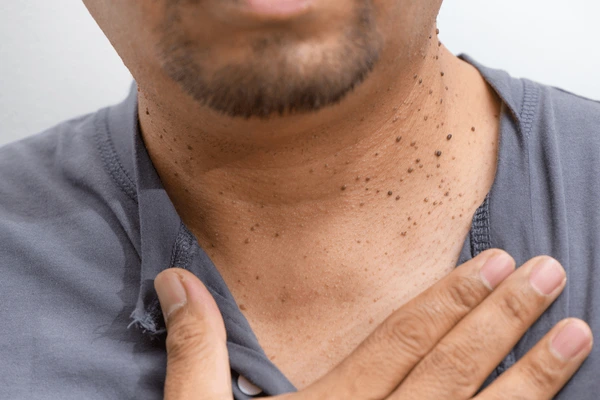
Skin tags (medically known as acrochordons) are soft, benign growths that extend from the skin on a thin stalk. They are extremely common and completely harmless from a medical standpoint, but many patients find them cosmetically bothersome or physically irritating, especially when they catch on clothing or jewellery.
What Do They Look Like?
- Soft, fleshy growths that hang or protrude from the skin
- Flesh-coloured or slightly darker than surrounding skin
- Attached by a thin stalk (peduncle)
- Size ranges from 1mm to over 1cm
- Surface is smooth or slightly wrinkled
- Most commonly found in skin folds: neck, armpits, groin, under the breasts, eyelids
What Causes Skin Tags?
The exact cause is not fully understood, but according to NHS guidance on skin tags, they are strongly associated with:
- Skin friction in body folds and areas where skin rubs against skin or clothing
- Obesity due to increased skin-on-skin contact
- Insulin resistance and Type 2 diabetes
- Hormonal changes during pregnancy
- Genetics as they tend to run in families
- They become more common with age
Most skin tags are harmless. However, you should have a growth evaluated by a doctor if it changes colour, bleeds without being touched, grows rapidly, or has an irregular shape or border. These features warrant professional assessment to rule out other conditions.
Oil Seeds vs Skin Tags: Side-by-Side Comparison
| Feature | Oil Seeds (Milia) | Skin Tags |
|---|---|---|
| Medical term | Milia | Acrochordons |
| Appearance | Small, round, white or yellow | Soft, flesh-coloured, hangs on stalk |
| Texture | Hard, firm | Soft, compressible |
| Size | 1 to 2mm typically | 1mm to 1cm or larger |
| Location | Face (eye area, cheeks, nose) | Neck, armpits, groin, eyelids |
| Cause | Trapped keratin under skin | Friction, insulin resistance, genetics |
| Pain or itch | No | No (unless irritated) |
| Goes away on its own | Rarely in adults | Very rarely |
| Can squeeze at home | No – causes scarring | No – risk of bleeding and infection |
| Requires medical attention | Yes for safe removal | Yes for safe removal |
How Are Oil Seeds Removed?
Milia removal is a minor clinical procedure. According to Mayo Clinic’s guidance on milia treatment, the most reliable method is manual extraction performed by a trained clinician.
At Vivardi Clinics, our process for milia removal is:
The area is thoroughly cleansed and assessed. We identify all milia present and note proximity to the eye area.
A fine sterile lancet is used to create a tiny opening in the skin over each milium. This step requires precision, especially around the eye.
The keratin contents are gently expressed using a comedone extractor. The procedure is virtually painless for most patients.
A soothing gel or light moisturiser is applied. Patients are advised to avoid heavy occlusive creams for several days post-procedure.
Multiple milia can typically be removed in a single session. There is no downtime. Redness may last a few hours post-procedure.
For patients with recurring milia, we also recommend reviewing their skincare routine. Heavy moisturisers, layered serums, and certain sunscreen formulations are common culprits that can trigger new milia formation.
What About Skincare Treatments for Milia?
Some dermatologists recommend retinoid creams or AHA exfoliants to support cell turnover and reduce milia recurrence. These can be helpful for prevention but are not effective at removing existing milia that have already formed. Professional extraction remains the only reliable way to physically remove them.
For patients also dealing with related skin concerns such as uneven texture or pigmentation, our Pico Laser treatment or chemical peels can complement milia removal by improving overall skin renewal.
How Are Skin Tags Removed?
Skin tag removal is a quick, low-risk procedure when performed by a trained clinician. There are several methods available, and the right one depends on the size, location, and number of skin tags being treated.
Method 1: Cryotherapy (Freezing)
Liquid nitrogen is applied to the skin tag, freezing the tissue and causing it to fall off within 1 to 2 weeks. Best for smaller skin tags. Minimal discomfort, slight stinging during application.
Method 2: Electrocautery (Heat)
A small electrical current is used to burn the base of the skin tag. The tag separates cleanly, with minimal bleeding. Suitable for most sizes and locations. A mild topical anaesthetic is applied first.
Method 3: Surgical Excision
For larger skin tags, a sterile scalpel or surgical scissors are used to remove the tag at its base under local anaesthetic. Clean, immediate result with no waiting for the tag to fall off. The most appropriate method for larger or multiple skin tags.
Vivardi Clinics also offers skin tags and warts removal using clinically appropriate methods matched to each patient’s specific concern.
Over-the-counter skin tag removal products (freezing kits, ligation bands, topical solutions) are widely available online. While some may work for very small skin tags on the body, they are not recommended for skin tags near the eyes, genitals, or on the face. Incorrect application can cause burns, scarring, and incomplete removal. If in doubt, have it assessed by a doctor first.
Can Skin Tags Come Back After Removal?
Removing a skin tag does not prevent new ones from forming in the same area, especially if the underlying cause (friction, insulin resistance, hormonal factors) has not been addressed. However, once a tag is fully removed at its base, that specific tag does not regrow.
Patients who notice an unusually high number of new skin tags appearing in a short period should consider checking their fasting glucose and insulin levels, as multiple new skin tags can sometimes be an early indicator of insulin resistance.
Oil Seeds and Skin Tags: Can You Have Both?
Yes, absolutely. They are independent conditions with different causes, and it is entirely possible to have both at the same time. In clinical practice, we often see patients who come in primarily for milia around the eyes but also have skin tags on the neck or axillae that they want addressed in the same visit.
Both can be treated in a single appointment, as the procedures are quick and minimally invasive.
What About HPV Warts? Are They the Same as Skin Tags?
No. This is a common source of confusion. Skin tags are benign growths with no infectious cause. HPV warts are caused by the Human Papillomavirus and are contagious. They have a rougher, more irregular surface compared to the smooth stalk of a skin tag and require different treatment methods entirely.
If you are unsure whether a growth is a skin tag or a wart, do not attempt home removal. Have it assessed by a doctor first.
What Does Removal Cost and How Many Sessions Are Needed?
Most milia and skin tag removal cases are resolved in a single session. Multiple milia or a cluster of skin tags can typically all be addressed in one visit. Cost varies based on the number of lesions and method used.
We recommend a brief consultation before treatment so that we can assess the lesions properly, confirm the diagnosis, and give you an accurate quote. There are no hidden fees or upselling of unnecessary add-ons.
Book a Skin Assessment at Vivardi Clinics
Oil seeds, skin tags, warts, or something else entirely? We will assess, diagnose, and give you an honest recommendation. Most removals are completed in a single visit.
📞 011-8888 6503
Pusat Komersial Anggun City, 63A-1, Jalan Anggun City 2, Rawang, Selangor
Summary: Key Takeaways
- Oil seeds (milia) are hard white keratin cysts, most common on the face, removed by sterile lancing and extraction
- Skin tags are soft flesh-coloured growths on stalks, found in skin folds, removed by cryotherapy, electrocautery, or excision
- Neither should be squeezed, cut, or treated with unverified home kits
- Both are removed quickly and safely in a single clinical visit
- Multiple skin tags appearing rapidly may warrant a glucose and insulin check
- If unsure whether a growth is a skin tag, wart, or something else, get it assessed before treating it
Related treatment: learn more about oil seeds removal at Vivardi.

Medically reviewed by Dr. Dinesh Kumar, Medical Director, Vivardi Clinics. MBBS (AIMST), LCP-Certified Aesthetic Physician, Cert. Men’s Health. Last reviewed October 2026.
Care at Vivardi is provided by our team of qualified doctors. This page is for general education and does not replace a personal consultation.