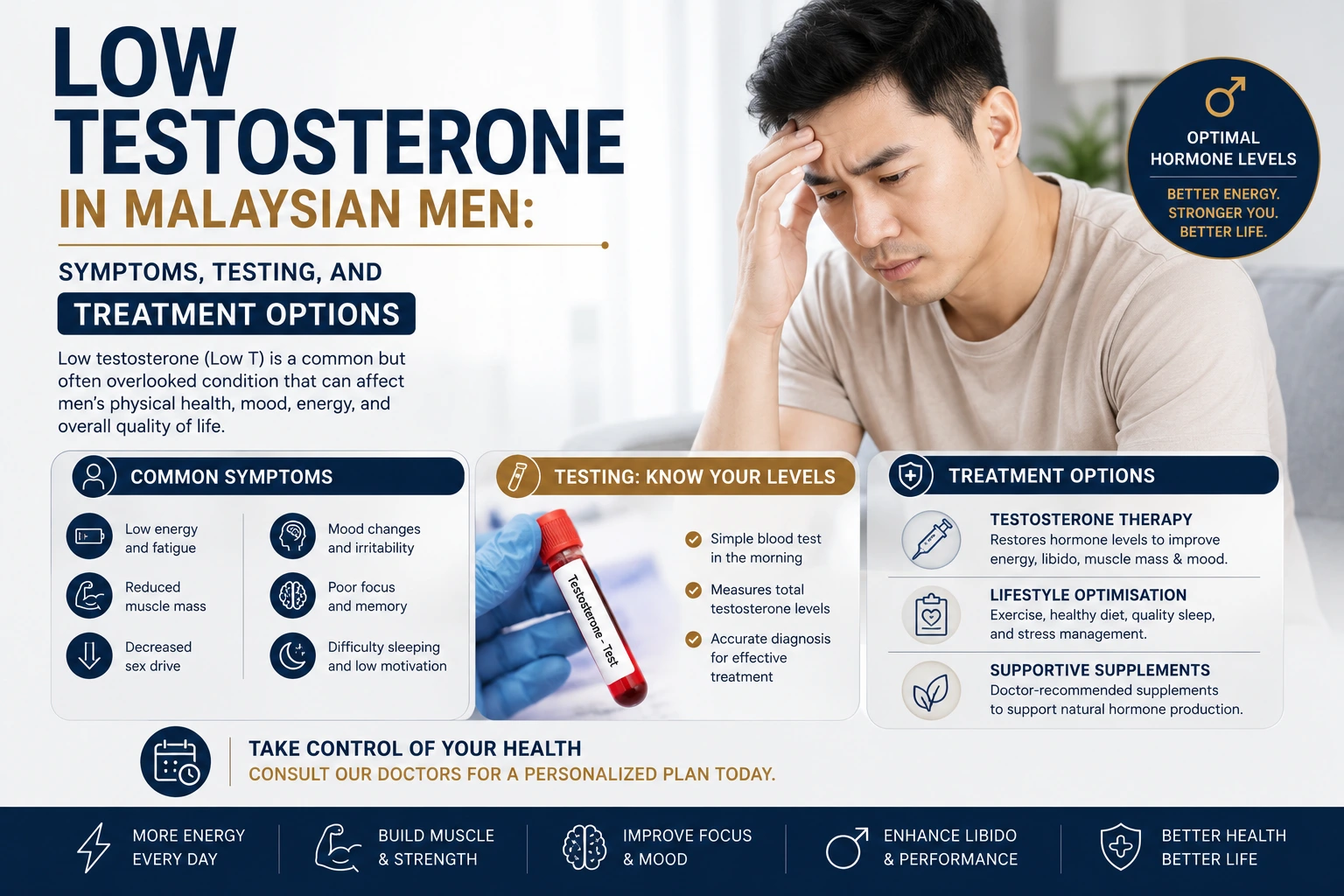
Low energy. Difficulty building muscle. A sex drive that has quietly disappeared. Mood that is flatter than it used to be. These are the kinds of changes that many Malaysian men write off as just getting older or being too stressed.
Sometimes that is true. But sometimes the cause is measurable and treatable: low testosterone.
This article explains what testosterone actually does, what the symptoms of low testosterone look and feel like, how it is properly tested, and what options exist for treatment in Malaysia.
This article is for educational purposes. Testosterone testing and treatment requires a consultation with a registered doctor. Self-medicating with testosterone is dangerous.
What Does Testosterone Actually Do?
Most people know testosterone as the male sex hormone, and that is accurate, but it understates how important it is. Testosterone is involved in almost every aspect of male health and function.
Here is what testosterone influences in your body:
- Muscle mass and strength — testosterone drives protein synthesis and muscle growth
- Fat distribution — low T causes fat to accumulate around the belly
- Bone density — testosterone helps maintain strong bones
- Red blood cell production — affects energy and endurance
- Sex drive (libido) — directly governs sexual interest in men
- Erections — testosterone plays a supporting role in erectile function
- Sperm production — essential for male fertility
- Mood and mental clarity — low testosterone is linked to depression, brain fog, and poor concentration
- Sleep quality — testosterone is partly produced during deep sleep and also affects sleep architecture
When testosterone levels drop below the normal range, many of these functions are affected simultaneously. That is why the symptom picture of low testosterone can feel like everything is slightly off at once.
At What Age Does Testosterone Start to Decline?
Testosterone peaks in most men in their late teens to mid-twenties. After around age 30, testosterone levels naturally decline at a rate of roughly 1% per year. By age 40, many men have meaningfully lower testosterone than they had at 25. By 50 and beyond, the decline is often clinically significant.
This natural age-related decline is sometimes called andropause or late-onset hypogonadism. However, low testosterone is not just an older man’s problem. Lifestyle factors, medical conditions, and even stress can push testosterone levels down in men in their 20s and 30s as well.
Symptoms of Low Testosterone: What to Watch For
The symptoms of low testosterone are often gradual and easy to explain away. Here is what to look for:
Physical Symptoms
- Unexplained fatigue even after adequate sleep
- Loss of muscle mass despite regular exercise
- Increased body fat, especially around the abdomen
- Reduced strength and physical endurance
- Joint aches and stiffness
- Hair loss or thinning on the body
- Breast tissue enlargement (gynaecomastia) in some cases
- Reduced beard growth or slower body hair growth
- Smaller testicular volume over time
Sexual Symptoms
- Noticeably reduced interest in sex (low libido)
- Difficulty achieving or maintaining erections
- Fewer spontaneous erections (for example, in the morning)
- Reduced semen volume
- Difficulty with orgasm intensity
Mental and Emotional Symptoms
- Low mood or mild depression without an obvious cause
- Poor concentration and memory
- Reduced motivation and drive
- Irritability or short temper
- Anxiety or a general sense of unease
The challenge with these symptoms is that they are also associated with poor sleep, stress, depression, obesity, and several other conditions. This is why testing is essential. Symptoms alone cannot diagnose low testosterone.
What Causes Low Testosterone?
There are two main categories: primary and secondary causes.
Primary Causes (Problem with the Testes)
- Klinefelter syndrome (genetic condition)
- Undescended testicles
- Injury or infection affecting the testes
- Cancer treatment including chemotherapy or radiation
- Orchitis (inflammation of the testes)
Secondary Causes (Problem with the Brain Signal)
- Pituitary gland problems or tumours
- Obesity (fat tissue converts testosterone to oestrogen)
- Type 2 diabetes
- Obstructive sleep apnoea
- Chronic stress and elevated cortisol
- Certain medications including opioids and steroids
- Excessive alcohol consumption
- Anabolic steroid use (paradoxically shuts down natural testosterone production)
Understanding the cause matters because it affects how treatment is approached. Secondary causes can sometimes be treated directly, restoring natural testosterone production without needing hormone replacement.
How Is Low Testosterone Tested?
The diagnosis of low testosterone requires a blood test. A single symptom questionnaire is not enough. At Vivardi Clinics, we measure:
- Total testosterone — the standard first measurement, taken in the morning when levels are at their peak
- Free testosterone — the active form that actually enters cells and does the work
- SHBG (Sex Hormone Binding Globulin) — a protein that binds to testosterone, affecting how much is available for use
- LH and FSH — hormones from the brain that signal the testes to produce testosterone, helping identify whether the issue is primary or secondary
- Prolactin — elevated prolactin can suppress testosterone
- Full blood count and liver function — baseline health markers
- PSA (Prostate Specific Antigen) — important before starting testosterone treatment
Testosterone testing must be done on a morning blood draw, ideally before 10am, because levels fluctuate throughout the day and are highest in the morning. Evening tests often show falsely low results.
What Are the Treatment Options?
If blood tests confirm low testosterone and symptoms are present, there are several treatment options available in Malaysia.
Testosterone Replacement Therapy (TRT)
TRT replaces the testosterone your body is not producing enough of. It comes in several forms:
- Testosterone injections — given every one to four weeks depending on the type; effective and affordable
- Testosterone gel — applied to the skin daily; provides steady levels but requires care around skin-to-skin contact with others
- Testosterone patches — worn on the skin, changed daily
- Testosterone pellets — implanted under the skin every three to six months; less common but provides very stable levels
Addressing Underlying Causes First
In younger men especially, addressing reversible causes is the first priority before starting TRT:
- Weight loss can significantly raise testosterone in overweight men
- Treating sleep apnoea often improves testosterone levels meaningfully
- Reducing alcohol consumption helps
- Improving sleep quality and managing chronic stress
- Stopping anabolic steroid use, though recovery of natural production can take months to years
Medications to Stimulate Natural Production
For younger men who want to preserve fertility, medications like clomiphene citrate can stimulate the brain to signal the testes to produce more testosterone naturally, rather than replacing it from outside. This approach maintains sperm production, which TRT suppresses.
Is Testosterone Replacement Safe?
When properly prescribed and monitored, TRT is generally safe for most men. However, there are important considerations:
- TRT suppresses natural testosterone production and typically leads to reduced sperm count while on treatment
- Haematocrit (red blood cell concentration) can rise, requiring monitoring
- Prostate health must be monitored with PSA testing
- TRT is not appropriate for men with active prostate or breast cancer
- Regular follow-up blood tests are essential every three to six months while on treatment
This is why testosterone therapy should never be self-administered or purchased without proper medical supervision. At Vivardi Clinics, all TRT patients follow a structured monitoring programme.
Will TRT Affect My Fertility?
This is one of the most important questions for younger men. Yes, testosterone replacement therapy does suppress sperm production in most men while they are taking it. If you are planning to have children in the near future, this needs to be discussed with your doctor before starting treatment.
Alternatives that preserve fertility, such as clomiphene or hCG therapy, can be considered for men who are concerned about this. Sperm production often recovers after stopping TRT, but the timeline varies and is not guaranteed.
Frequently Asked Questions
What is considered a normal testosterone level in Malaysia?
Normal total testosterone for adult men is generally considered to be between 300 and 1,000 nanograms per decilitre (ng/dL), though reference ranges vary slightly between laboratories. Symptoms matter as much as the number. A man with 350 ng/dL and significant symptoms may benefit from treatment, while another at the same level with no symptoms may not.
Can I boost testosterone naturally without medication?
For men with mildly low testosterone, lifestyle changes can make a meaningful difference. These include regular resistance exercise, adequate sleep (seven to eight hours per night), reducing body fat especially abdominal fat, minimising alcohol, and managing chronic stress. However, for clinically significant low testosterone, lifestyle changes alone are rarely sufficient.
Does eating certain foods boost testosterone?
No food reliably raises testosterone to clinical significance. A balanced diet with sufficient healthy fats, zinc, and vitamin D supports healthy testosterone levels, but no specific food or supplement is a substitute for medical treatment when testosterone is clinically low.
How quickly does TRT work?
Most men notice improvements in energy and mood within two to four weeks. Libido improvements often follow within four to six weeks. Physical changes including muscle gain and fat loss take longer, typically three to six months of consistent treatment with appropriate diet and exercise.
Book a Men’s Health Assessment at Vivardi Clinics Rawang
If you recognise yourself in the symptoms described in this article, a simple blood test can tell you whether low testosterone is a factor. There is no reason to live with symptoms that are diagnosable and treatable.
At Vivardi Clinics Rawang, our men’s health assessment covers testosterone levels, related hormones, and a full clinical review. Everything is handled confidentially by our registered doctor.
Call or WhatsApp: 011-8888 6503
Pusat Komersial Anggun City, 63A-1, Jalan Anggun City 2, Taman Anggun, 48000 Rawang, Selangor
This article is educational only. All testosterone testing and treatment decisions must be made in consultation with a registered medical practitioner.
Related treatment: learn more about testosterone replacement therapy in Malaysia.

Medically reviewed by Dr. Dinesh Kumar, Medical Director, Vivardi Clinics. MBBS (AIMST), LCP-Certified Aesthetic Physician, Cert. Men’s Health. Last reviewed October 2026.
Care at Vivardi is provided by our team of qualified doctors. This page is for general education and does not replace a personal consultation.