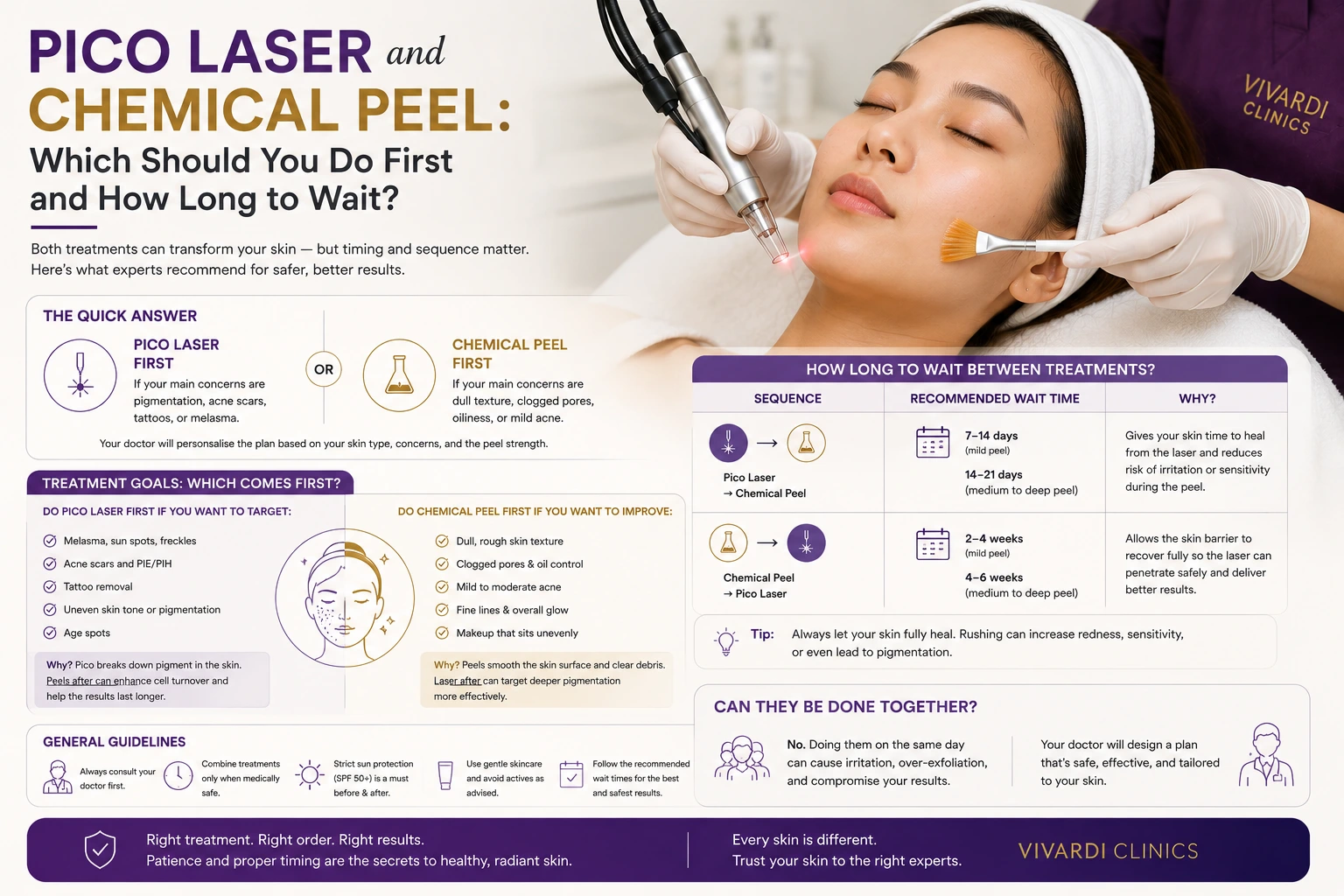
Short answer: In most cases the smarter order is a chemical peel first, then pico laser, with time to heal in between, but the right sequence genuinely depends on your skin, your concern, and the strength of each treatment. The reason is simple. A peel resurfaces and preps the skin, and doing laser on freshly peeled, sensitive skin raises the risk of irritation and pigmentation. Most clinicians therefore space the two treatments rather than stacking them on the same day, often leaving around two to four weeks between them, and they will not do a strong peel and a laser together on sensitive or pigmentation prone skin. The one firm rule is that this should be planned by a clinician, not improvised, because getting the order or timing wrong can cause the very pigmentation you are trying to fix.
If you have both pigmentation and texture concerns, you have probably wondered whether to book a pico laser, a chemical peel, or both, and in what order. This is a common and sensible question, and the honest answer has some nuance. This guide explains how each treatment works, why sequence and spacing matter, and how a doctor led plan puts them together safely.
Two different tools for overlapping problems
Pico laser and chemical peels both improve skin tone and texture, but they work in different ways, which is why they are often used together rather than as either or.
A chemical peel applies a solution to the skin that exfoliates the surface layers in a controlled way. Depending on strength, it lifts dead cells, unclogs pores, fades surface pigmentation, and stimulates fresh, smoother skin to come through. It works from the surface down. Our chemical peel page covers this in more detail.
A pico laser delivers ultra short pulses of energy that shatter pigment deeper in the skin and stimulate collagen, with less heat than older lasers. It reaches pigment and stimulates remodelling at a level that surface exfoliation cannot. Our pico laser page explains how.
Because a peel works more on the surface and pico works deeper, combining them thoughtfully can address more than either alone. The key word is thoughtfully. Stacking two resurfacing or pigment treatments carelessly stresses the skin and can backfire, especially on Asian skin that is prone to pigmentation.
Which should you do first?
Here is the practical logic most clinicians follow, with the caveat that your skin may need a different plan.
Chemical peel first, then pico laser, is the common approach. A peel resurfaces and refreshes the skin and clears some surface pigmentation and congestion. Once the skin has healed from the peel, pico laser then addresses the deeper pigment and stimulates collagen on skin that is smoother and better prepped. Doing it this way avoids firing a laser at skin that is freshly peeled, raw, and sensitive.
Pico laser is generally not done immediately after a peel, because peeled skin is more reactive and its barrier is temporarily compromised. Laser on that skin increases the risk of irritation, prolonged redness, and post treatment darkening.
Spacing is the safer default. Rather than doing both in one visit, most plans separate them, commonly by a couple of weeks up to a month, so the skin recovers from one before the next. The exact gap depends on the strength of the peel and the laser and how your skin responded.
There are exceptions. A very light, superficial peel and a gentle laser might sometimes be used closer together in experienced hands, and the order can flip for certain goals. But as a general, safe rule of thumb: peel first, heal, then laser, with time in between. And the plan should always be set after a skin assessment, not copied from someone else’s routine.
How long should you wait between them?
There is no single number that fits everyone, because it depends on the strength of each treatment and how your skin reacts, but here is a realistic guide.
- After a chemical peel, before a pico laser: commonly around two to four weeks, so the skin has fully recovered its barrier and settled. A stronger peel needs a longer gap.
- Between pico laser sessions: typically a few weeks, depending on the concern and settings.
- Never rush a second treatment onto skin that is still red, flaking, or sensitive from the first. Waiting until the skin has calmed is what keeps you safe from pigmentation.
Your clinician sets the exact timing based on how your skin looks and feels, which is why follow up matters. The temptation to compress treatments to see faster results is exactly the temptation that causes problems.
Can you combine them in the same session?
Sometimes, but cautiously, and only when a clinician judges it safe for your skin. A very gentle, superficial peel combined with a conservative laser might be used together in some experienced settings. However, for most people, and especially for pigmentation prone or sensitive skin, combining a meaningful peel and a laser in one session raises the risk of irritation and post inflammatory pigmentation, which is the opposite of the goal.
The safer, more common approach is to separate them and let the skin recover between treatments. If you are treating melasma, in particular, the whole plan leans conservative, because melasma is easily aggravated by too much heat or too much exfoliation at once. This is a clear case where a doctor’s judgement protects your skin from an enthusiastic but risky plan.
Why this matters more on Asian skin
Asian and darker skin is more prone to pigmentation, both the pigmentation you are treating and new pigmentation triggered by over aggressive treatment. That double edged nature is exactly why the sequence and spacing of peels and laser matter so much here. Too much, too fast, or the wrong order can leave the skin darker rather than clearer, and that post inflammatory pigmentation can take months to fade.
The safe path is a measured plan: appropriate strengths, adequate healing time between treatments, and diligent sun protection throughout. A doctor led clinic that understands Asian skin builds this in automatically. This is the main reason to avoid bargain, high volume venues that apply the same routine to everyone regardless of skin type. Our pigmentation therapy resources explain how pigmentation is best managed as a whole.
Sun protection ties the whole plan together
Whatever the order, one thing is constant: sun protection is essential before and after both treatments. Freshly resurfaced or lasered skin is more vulnerable to the sun, and sun exposure is a leading cause of the post treatment darkening people fear. In the Malaysian climate, daily broad spectrum sunscreen, reapplied through the day, is not an optional extra. It is part of the treatment.
Skipping sunscreen after a peel or laser is one of the fastest ways to undo the result and even cause new pigmentation. If you are not prepared to commit to sun protection, that is worth discussing honestly with your clinician before starting, because it changes the plan.
Preparing your skin and setting expectations
A good plan often starts before either treatment, with a short period of skin preparation, such as the right skincare to strengthen the barrier and settle any active pigmentation, so the skin is in the best condition to respond. Your clinician may recommend a few weeks of prep for pigmentation prone skin.
Expectations also matter. Both peels and laser usually work over a course, not a single session, and pigmentation especially is a gradual, ongoing process rather than a one time fix. Melasma can be improved but tends to recur without maintenance and strict sun care. Understanding this upfront means you judge the results fairly and stick with the plan that actually works.
Why a doctor led clinic in Rawang
Vivardi Clinics is a doctor led aesthetic and men’s health clinic in Rawang, Selangor. Combining a chemical peel and pico laser is exactly the kind of plan that benefits from medical judgement, because the order, the strengths, and the spacing all need to be matched to your skin type and concern to be safe and effective. We assess your skin, prep it where needed, sequence the treatments sensibly, and guide the sun protection that protects your result. Consultations are private and we follow the PDPA Act Malaysia.
Frequently asked questions
Should I have a pico laser before or after a chemical peel?
In most cases a chemical peel is done first, the skin is allowed to heal, and pico laser follows a few weeks later. Doing laser on freshly peeled, sensitive skin raises the risk of irritation and pigmentation. The exact order should be set by a clinician based on your skin.
Can I do pico laser and a chemical peel on the same day?
Sometimes a very gentle peel and a conservative laser can be combined in experienced hands, but for most people, especially pigmentation prone skin, they are better separated to avoid irritation and post treatment darkening.
How long should I wait between a chemical peel and pico laser?
Commonly around two to four weeks, longer after a stronger peel, so the skin fully recovers. Never do the second treatment on skin that is still red, flaking, or sensitive.
Why does the order matter more for Asian skin?
Asian and darker skin is more prone to pigmentation, including new pigmentation from aggressive treatment. Getting the order or spacing wrong can leave the skin darker, so a measured, doctor led plan with proper healing time is important.
Do I still need sunscreen between treatments?
Yes, absolutely. Freshly treated skin is more vulnerable to the sun, and sun exposure is a leading cause of post treatment darkening. Daily broad spectrum sunscreen is part of the treatment, not optional.
Will one session fix my pigmentation?
Usually not. Both peels and laser typically work over a course, and pigmentation, especially melasma, is a gradual process that often needs maintenance and ongoing sun protection to keep results.
Book a consultation
If you have both pigmentation and texture concerns and are not sure how to combine treatments safely, a skin assessment will map out the right order and spacing for your skin. Book a consultation or contact Vivardi Clinics in Rawang, Selangor. Everything is handled privately, by qualified doctors.
This guide was written and reviewed by the medical team at Vivardi Clinics in Rawang, Selangor. Last reviewed July 2026. It offers general education and is not a substitute for advice from your own doctor.

Medically reviewed by Dr. Dinesh Kumar, Medical Director, Vivardi Clinics. MBBS (AIMST), LCP-Certified Aesthetic Physician, Cert. Men’s Health. Last reviewed September 2026.
Care at Vivardi is provided by our team of qualified doctors. This page is for general education and does not replace a personal consultation.