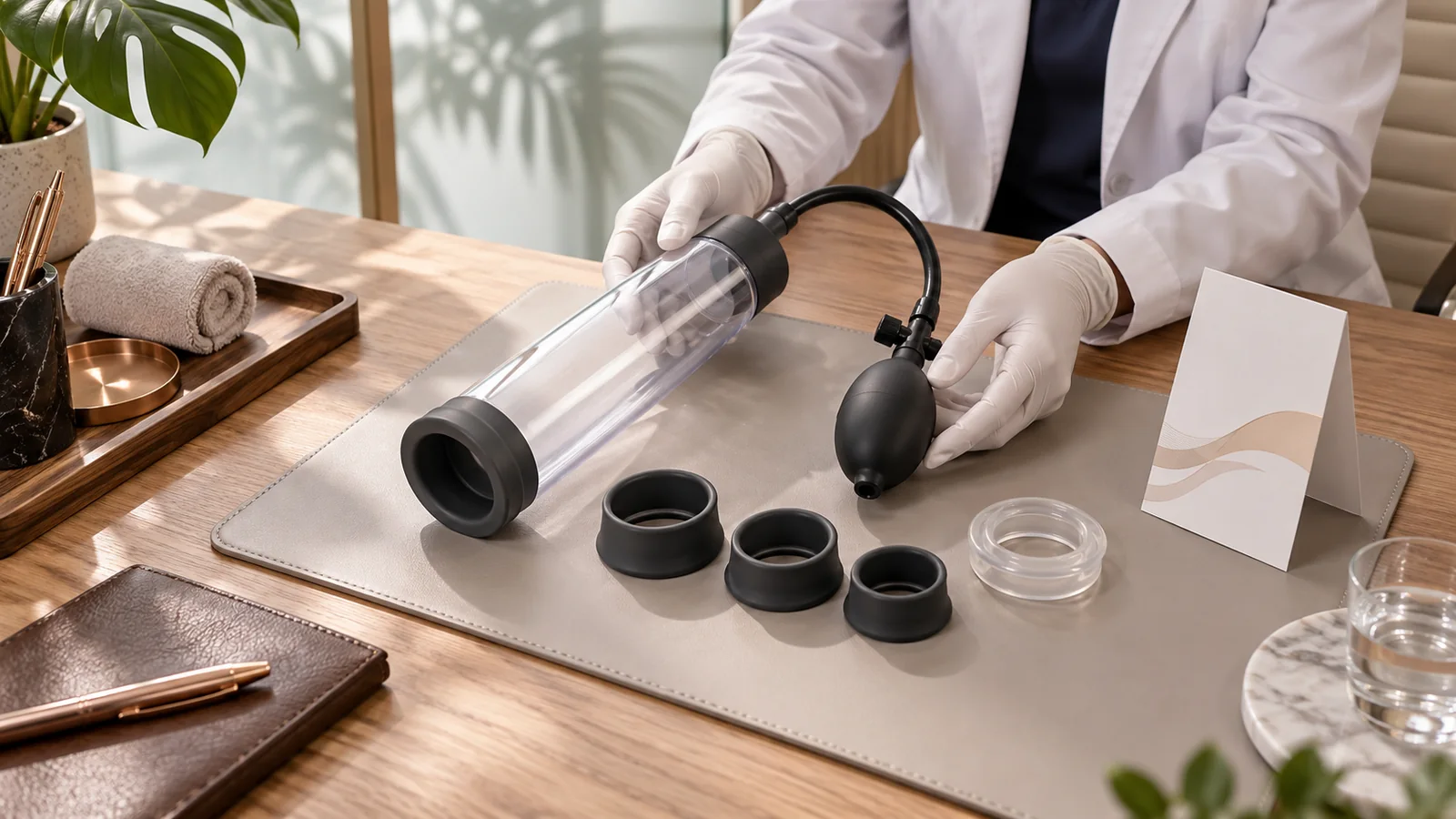
A penile vacuum pump for ED can create an erection without an oral drug by drawing blood into the penis. A constriction ring may then hold the blood temporarily. It can be useful when tablets are unsuitable or ineffective, but safe use requires correct sizing, gradual pressure, a vacuum limiter and strict attention to ring time.
Quick answer: is a penile vacuum pump safe?
A medical-grade vacuum erection device is safe for many men when selected and taught by a healthcare professional. Expected effects can include temporary coldness, numbness, purple colour, small red spots, bruising or weaker ejaculation. Men taking blood-thinning medicine, those with sickle cell disease or another bleeding or clotting disorder, and men with penile injury or reduced sensation need medical advice before use. Remove the constriction ring within 30 minutes.
What is a vacuum erection device?
A vacuum erection device has a clear cylinder placed over the penis, a manual or battery pump, and sometimes an elastic constriction ring. The pump removes air from the cylinder. Lower pressure around the penis encourages blood to enter the erectile tissue. Once sufficient firmness is reached, the ring is moved to the base before the cylinder is removed.
The ring is not always used during rehabilitation sessions where the goal is temporary blood flow rather than intercourse. Instructions differ after prostate surgery and for routine ED. Do not improvise with household pumps or use a sexual novelty product that lacks pressure control.
What a pump can and cannot do
It can
- Create an erection mechanically
- Be used when some medicines are unsuitable
- Work despite certain nerve or vascular causes
- Support rehabilitation in selected patients
- Be combined with other treatment under advice
It cannot
- Cure diabetes or vascular disease
- Restore sexual desire by itself
- Guarantee a natural-feeling erection
- Permanently enlarge the penis
- Replace medical investigation of persistent ED
Who may benefit?
A vacuum device may suit men who cannot take PDE5 inhibitor tablets, do not respond adequately, prefer a non-drug option or are recovering after prostate treatment. It may help ED related to diabetes, pelvic surgery, neurological disease or mixed causes. Manual dexterity and partner support can affect practical success.
The NHS notes that pumps encourage penile blood flow and can be used when medicine does not suit or does not work. Suitability is still individual. A doctor should assess recurrent ED because high blood pressure, diabetes, cholesterol, hormone problems, medicines, sleep and psychological factors may need treatment.
Who should avoid it or seek specialist advice first?
- Men taking anticoagulants or antiplatelet medicine, because bruising and bleeding risk may be higher
- Men with sickle cell disease or a disorder that increases bleeding, clotting or priapism risk
- Men with reduced penile sensation who may not feel excessive pressure
- Men with active infection, open wounds, severe skin disease or recent penile injury
- Men with severe penile curvature or painful Peyronie’s disease
- Men with a penile implant or recent pelvic surgery unless cleared by the treating team
- Men who cannot operate the pressure release or remove the ring safely
This list is not complete. Tell the clinician about all medicines, supplements, surgery and health conditions. Do not stop blood thinners solely to use a pump.
Choosing a safer device
Look for a medical device from a reputable supplier with several cylinder or ring sizes, clear instructions, an easy pressure-release valve and a vacuum limiter that prevents excessive suction. A good seal should not require painful force.
Online enlargement pumps may use high pressure or lack a limiter. Pressure gauges do not make an unregulated device safe. Ask who manufactured it, whether replacement rings are available and how it is cleaned.
Step-by-step use
- Prepare privately: read instructions, inspect the device and make sure the release valve works.
- Trim if needed: pubic hair caught at the base can prevent a seal or become trapped.
- Select the ring: it must maintain firmness without severe pain or marked discolouration.
- Apply lubricant: use a compatible water-based lubricant around the cylinder base and penis.
- Place the cylinder: centre it against the body and create a seal.
- Pump gradually: use slow, small increases. Stop for pain, pinching or concerning colour change.
- Pause and adjust: release some pressure if uncomfortable. More suction is not a better erection.
- Transfer the ring: once firm, slide the ring to the base using the device mechanism.
- Remove the cylinder: release the vacuum first.
- Remove the ring on time: never exceed 30 minutes. Remove earlier for pain, numbness or marked coldness.
Non-negotiable safety rule
Never leave a constriction ring in place longer than 30 minutes. Prolonged restriction can injure tissue. Do not fall asleep, use intoxicating substances or set up a situation where the ring cannot be removed promptly. Seek urgent care if it becomes stuck or the penis remains painfully erect after removal.
How much pressure should be used?
Use the minimum pressure needed to draw blood gradually. Pumping rapidly or chasing maximum size raises the risk of petechiae, bruising, pain and tissue injury. A vacuum limiter is a safety feature, but it does not replace proper technique.
If the erection is inadequate, check the seal, hair, lubricant and cylinder position before adding pressure. The ring size may be wrong. Training can solve problems that brute force cannot.
Expected side effects
| Effect | Why it may happen | Response |
|---|---|---|
| Cold or numb feeling | The ring reduces venous outflow and the erection differs from a natural one. | Remove early if uncomfortable; review ring size. |
| Purple or bluish colour | Blood is temporarily trapped. | Mild change can occur, but severe pain, very dark colour or prolonged change needs review. |
| Petechiae | Tiny capillaries bleed under excessive or unfamiliar pressure. | Pause use and discuss technique, especially with blood thinners. |
| Bruising | Suction or the ring can injure small vessels. | Stop until resolved and obtain advice if extensive. |
| Pain or pinching | Pressure, trapped skin or a ring that is too tight. | Release immediately. Pain is not a target. |
| Weak or uncomfortable ejaculation | The ring may restrict semen flow. | Discuss ring design and expectations. |
What the erection may feel like
A vacuum-assisted erection may feel cooler and look more purple. The base can be less firm, allowing some pivoting. The ring may reduce ejaculation, but orgasm can still occur. Preparing both partners reduces surprise and performance pressure.
Practice without the expectation of intercourse. Learn the seal, pump and release while calm. Successful use often improves after several supervised or low-pressure attempts.
Using lubricant safely
Lubricant helps the seal and reduces skin pinching. Use a water-based product compatible with the cylinder, ring and condoms. Oil-based products can damage some condoms and materials. Avoid numbing creams because pain is an important warning signal.
Too much lubricant can make the ring difficult to control. Clean excess from the hands before transfer. Stop if a product causes rash or burning.
Choosing and removing the constriction ring
A ring that is too loose loses firmness; one that is too tight causes pain, numbness and excessive colour change. Start with the size recommended by the trainer. Never stack rings unless specifically instructed by a healthcare professional and the device manufacturer.
Know the release method before use. Keep scissors away from the penis unless emergency professionals direct you. If swelling makes removal difficult, use the release technique and seek urgent assistance rather than waiting.
Cleaning and storage
Follow manufacturer instructions. Many devices are cleaned with warm water and mild soap, but battery or pump components may not be immersible. Allow parts to dry completely. Do not share a device or ring because blood or bodily fluids may contaminate it.
Inspect for cracks, rough edges, stretched rings and a faulty valve. Store away from heat, children and anyone who may use it without instruction.
Vacuum pumps and blood-thinning medicines
Warfarin, apixaban, rivaroxaban, dabigatran, clopidogrel, aspirin and other medicines can increase bruising or bleeding. The degree of risk depends on the medicine, indication, dose and health. Never pause a blood thinner for sexual activity without the prescriber.
A clinician may recommend another option or extra caution. Report extensive bruising, blood in urine, bleeding from skin or a painful swelling.
Sickle cell disease and blood disorders
Conditions associated with priapism, abnormal clotting or bleeding require specialist advice. Vacuum and constriction change penile blood flow. Men with sickle cell disease should not experiment without medical supervision.
Priapism is a painful erection lasting four hours or more and is an emergency. It can damage erectile tissue permanently.
After prostate surgery
Vacuum devices are sometimes included in penile rehabilitation after radical prostatectomy. The aim may be to encourage tissue oxygenation and maintain length while nerves recover, with or without a ring. Start time and frequency depend on surgical healing.
Do not copy another patient’s protocol. Ask the surgeon when wounds have healed, whether lymphatic swelling or hernia affects use, and what symptoms require stopping.
Vacuum pump versus ED tablets
Tablets enhance the natural nitric oxide pathway and need sexual stimulation. A pump creates an erection mechanically. Tablets may be convenient but are unsafe with nitrate medicine and may cause headache, flushing or other effects. A pump avoids systemic drug interaction but requires equipment, practice and a ring.
Some men use both under medical guidance. Do not combine treatments to create maximum firmness without instruction, because prolonged erection and injury risk can increase.
Vacuum pump versus shockwave or injections
Low-intensity shockwave aims to influence vascular tissue over a treatment course, while a pump produces an erection for a particular occasion or rehabilitation session. Penile injections use medicine and can create reliable erections but carry priapism and fibrosis risks.
The Vivardi ED treatment hub explains the clinic’s pathways, including shockwave, P-Shot, exosome and vacuum pump therapy. Evidence and suitability differ. A device should not be promoted as a cure for every cause.
Does a pump permanently enlarge the penis?
No reliable evidence shows that an erection pump permanently enlarges a normal penis. It causes temporary expansion by drawing in blood. Excessive pressure or prolonged use can cause bruising, pain and tissue damage. Enlargement marketing should not be confused with medical ED use.
When the pump does not work
Common problems include a poor seal, pubic hair, insufficient lubricant, incorrect cylinder position, a ring that is too loose, anxiety or difficulty operating the device. Training and trying different approved ring sizes can help.
Do not keep raising pressure. If the erection cannot be achieved or maintained despite correct technique, return for review. Severe vascular disease, fibrosis or another diagnosis may affect response.
Partner communication
Explain the steps before intimacy. The pause for pumping does not mean a lack of desire. A partner can assist with the cylinder or ring if both are comfortable and trained. Agree on a stop signal for pain.
Make the device part of foreplay rather than a test. If either partner feels pressured, pause and discuss alternatives.
A realistic first-use plan
The first attempt is best treated as a practice session rather than a performance test. Read the instructions in daylight, identify the pressure-release control and confirm that the ring can be removed easily. Practise placing the empty cylinder before involving a partner. This reduces urgency and makes it easier to notice discomfort.
Use the lowest pressure that produces an adequate response. Building the vacuum gradually may take several short cycles. If skin is pulled painfully into the cylinder, release the pressure, reposition and check the seal. Stop if pain persists. More pressure does not guarantee a firmer or safer erection.
A clinician may ask you to record the device model, ring size, time required, erection quality and any bruising. That practical information is more useful than simply saying that the device worked or failed. It helps distinguish a technique problem from a device mismatch or a medical reason for poor response.
Vacuum therapy as part of a wider ED plan
A pump addresses erection mechanics, but a complete plan may also include blood pressure, glucose and cholesterol review, smoking cessation, exercise, sleep assessment and treatment of anxiety or relationship strain. Persistent ED can be associated with vascular, neurological, hormonal or medication-related factors. A device should not delay appropriate investigation.
Some patients use a vacuum device alone. Others use it when tablets are unsuitable or insufficient, or alongside another clinician-directed treatment. Combinations are not automatically safer or more effective. For example, adding medicine or an injection can change the risk of a prolonged erection. Every component should be disclosed to the treating doctor.
When to stop and arrange a review
Pause use and arrange a non-urgent review if bruising repeatedly returns, the correct ring never maintains firmness, sensation is reduced, curvature or a new lump appears, or the process consistently causes distress. These findings may require a different cylinder, ring, technique or treatment strategy.
Seek urgent medical care for severe or escalating pain, a ring that cannot be removed, significant bleeding, a cold or very dark penis that does not recover after release, or an erection that remains painful and prolonged. Do not try to solve a stuck ring with sharp tools. Tell the emergency team exactly what device and medicines were used and when.
Questions to ask before buying
- Is the device intended for medical erection support?
- Does it include a reliable vacuum limiter and quick-release valve?
- Are several ring sizes available?
- Can replacement seals and rings be obtained?
- Are the cleaning instructions compatible with the materials?
- Is training or customer support available?
- Can the cylinder accommodate your anatomy without pinching?
- What is the return process if the fit is unsuitable?
A very cheap device without pressure control, instructions or traceable support may expose the user to avoidable injury. Marketing photographs and enlargement promises are not evidence of medical quality. Bring the product details to a consultation if you are uncertain.
Practical safety checklist
- Obtain a medical assessment for recurrent ED.
- Use a reputable device with a vacuum limiter.
- Learn the release valve before pumping.
- Use gradual pressure and stop for pain.
- Select the correct ring size.
- Never exceed 30 minutes with the ring.
- Do not sleep or become intoxicated while using it.
- Clean and inspect the device.
- Seek urgent care for a stuck ring or priapism.
Frequently asked questions
How long can the constriction ring stay on?
No longer than 30 minutes. Remove it sooner for pain, numbness, severe coldness or marked discolouration.
How often can a vacuum pump be used?
Frequency depends on whether it is used for intercourse or rehabilitation. Follow the clinician and manufacturer protocol.
Is purple colour normal?
A darker colour can occur while blood is trapped, but severe pain, very dark tissue or colour that does not resolve needs assessment.
Can I use a pump with warfarin?
Bleeding risk may be higher. Do not use it until the prescriber or treating clinician has assessed safety.
Can a pump cure ED?
It creates an erection mechanically but does not cure diabetes, vascular disease, nerve injury or anxiety.
Can it permanently enlarge the penis?
No reliable evidence supports permanent enlargement. Excessive use can injure tissue.
Why is ejaculation weaker?
The constriction ring can restrict semen flow. Orgasm may still occur.
What if the ring becomes stuck?
Use the device’s release instructions immediately and seek urgent medical help if it cannot be removed.
Can it be used after prostate surgery?
Often, but only according to the surgical team’s timing and rehabilitation plan.
Should I buy a pump online?
Ask a clinician to recommend a reputable medical device with a limiter, correct sizes and clear support.
Related Vivardi reading
Compare the device with shockwave therapy for ED and learn when testosterone assessment may be relevant. These approaches address different causes and should not be combined without medical advice.
Medical references
Learn safe vacuum-pump technique privately
Vivardi Clinics can assess the cause of ED, check contraindications and explain correct device selection and use.
Medically reviewed by Dr. Dinesh Kumar. This guide is general education and does not replace device training, diagnosis or emergency care.