Testosterone shapes your energy, drive, muscle and mood. When it drops too low, daily life takes the hit. At Vivardi Clinics in Rawang, our doctors offer medically supervised TRT using approved formulations, started only after blood tests confirm you need it.

Quick summary
Your enquiry is kept strictly confidential and handled in line with Malaysia's PDPA.
If several of these sound familiar, a simple blood test can tell you where your levels stand.

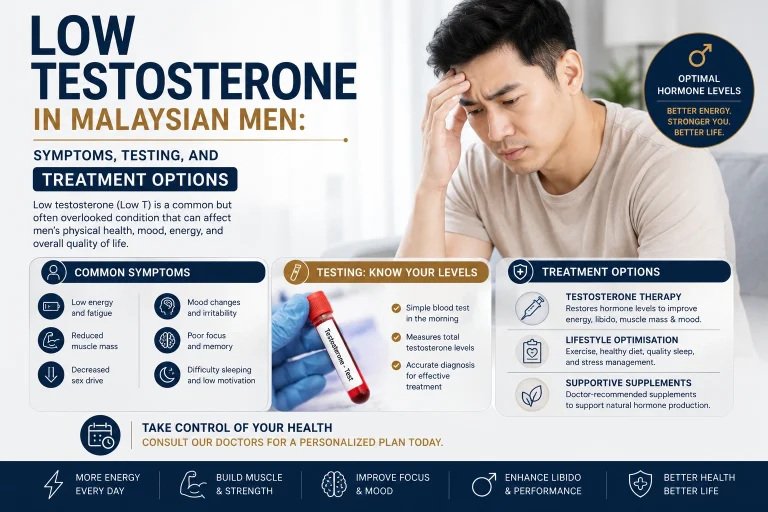
Persistent tiredness and fatigue even after rest.
Lower sex drive and changes in sexual performance.
Loss of muscle mass and strength despite effort.
Increased body fat, often around the middle.
Irritability, low mood or feeling flat.
Brain fog, low motivation and trouble concentrating.
Testosterone Replacement Therapy restores testosterone in men diagnosed with low levels, also known as hypogonadism. It eases the symptoms of deficiency while keeping your hormones safe and balanced. Treatment only begins after a proper assessment and blood tests. Here is what it helps with:

Your doctor recommends the option that fits your levels, lifestyle and preference, whether injection or gel.
Long-acting testosterone undecanoate injection given every few months for stable levels with fewer injections.
A short to medium-acting injectable, usually given weekly or biweekly depending on your needs.
Similar to enanthate, with flexible dosing for steady testosterone replacement.
A blend of testosterone esters giving both an immediate and a sustained release.
A topical testosterone gel applied daily to the skin, ideal if you prefer a non-injectable option.
Your plan is personalised and reviewed regularly to keep it safe and effective.
A medical consultation and symptom assessment to understand how you feel.
Blood tests to confirm testosterone deficiency before any treatment starts.
We start a TRT protocol matched to your levels, lifestyle and goals.
Regular follow ups and blood monitoring to fine-tune your dose.
TRT at Vivardi is carried out under close medical supervision. We use regular blood tests to monitor your hormone levels, prostate health and overall safety, and adjust the plan whenever needed.

More daily energy and drive.
Improved sex drive and sexual function.
Better muscle strength and tone.
Steadier mood and sharper focus.
Support for stronger bones over time.
A general lift in vitality and quality of life.
MBBS (AIMST) · LCP Certified Aesthetic Physician · Certificate in Men's Health. Dr. Dinesh leads the men's health programme at Vivardi and personally reviews each TRT plan.

Testosterone naturally falls with age, often from the early 30s, by roughly 1 percent a year. For many men the drop is gradual and manageable, but several other factors can push levels lower or bring symptoms on sooner. Doctors group the causes into primary hypogonadism, where the testicles do not make enough testosterone, and secondary hypogonadism, where the signal from the brain to the testicles is reduced.
Identifying the cause matters, because it shapes whether TRT alone is enough or whether lifestyle and other conditions need attention too.

We never start TRT on symptoms alone. A blood test confirms whether your levels are genuinely low, and gives us a baseline to monitor against. Testosterone is highest in the morning, so we usually test before noon and often repeat it on a second day to be sure.
The core measures of how much testosterone you have and how much is active.
Pituitary hormones that tell us whether the issue is in the testicles or the brain signal.
Plus blood count, blood sugar, lipids and prostate markers for a full, safe picture.
Both restore testosterone effectively. The right choice comes down to how often you want to dose and your personal preference.
Nebido, Enanthate, Cypionate or Sustanon, given anywhere from weekly to once every few months.
Suits you if you prefer fewer doses and steady, reliable levels, and you do not mind injections.
A gel applied to the skin once a day, with no needles involved.
Suits you if you would rather avoid injections and are happy with a simple daily routine, taking care to avoid skin contact with others after applying.
TRT works in stages. Knowing the timeline helps you stay patient and consistent through the first few months.
Many men notice improved mood, drive and a returning interest in sex.
Libido, erections and energy continue to improve and become more stable.
Gains in muscle strength, fat loss and exercise performance become clearer.
Body composition and bone density continue to benefit with steady treatment.
For the right candidates, TRT is well established and safe when monitored. Like any treatment it carries some risks, which is exactly why we run regular blood tests and reviews. TRT may not be suitable, or needs extra caution, in certain situations.
We screen for all of this during your assessment, so treatment is only started when it is genuinely safe for you.

Assessed and supervised by our LCP-certified medical team.
We treat confirmed low testosterone, never symptoms alone.
Injections or gel, matched to your lifestyle and preference.
Confidential consultations handled under Malaysia's PDPA.
Easy to reach from across Rawang and the Klang Valley.
Regular reviews to keep your dose right and your health protected.
For some men, simple lifestyle changes lift testosterone enough to ease symptoms, and for everyone on TRT these habits help the therapy work better. We always look at these first.
Most testosterone is released during deep sleep, so seven to eight hours matters.
Strength training and staying active both support healthy testosterone.
Carrying less belly fat is one of the most effective natural boosts.
Chronic stress raises cortisol, which works against testosterone.
Enough vitamin D, protein and a balanced diet all play a part.
Heavy drinking over time lowers testosterone, so moderation helps.
If your levels are clinically low, lifestyle alone may not be enough, and that is where medically supervised TRT comes in.
Speak with our doctors in Rawang about whether medically supervised TRT is right for you. Private, professional and guided by your blood results.
Tiredness, low mood, reduced libido and erectile difficulty are not specific to low testosterone. Sleep apnoea, obesity, diabetes, thyroid disease, medicines, stress and depression can produce similar symptoms. A useful assessment connects symptoms with at least two appropriately timed morning testosterone results and investigates the likely cause.
Symptoms, fertility plans, sleep, sexual health, medicines, testicular history, cardiovascular risk and prostate history should be discussed privately.
Testing may include repeat morning testosterone, full blood count, PSA when appropriate, glucose or lipids and pituitary-related hormones based on the findings.
Response is judged by symptoms and safety markers, not by pushing testosterone above the normal physiological range.
| Area | Realistic expectation | Monitoring point |
|---|---|---|
| Sexual symptoms | Libido or sexual symptoms may improve when true hypogonadism is present, but TRT does not correct every cause of erectile dysfunction. | Review symptoms and consider a separate ED assessment. |
| Energy and body composition | Some men improve gradually. Sleep, nutrition, activity and metabolic health remain important. | Review clinical benefit after an appropriate trial. |
| Safety | Testosterone may increase haematocrit and can suppress sperm production. | Check blood count, testosterone and prostate-related measures when clinically appropriate. |
TRT should not be started simply because of age, gym goals or one borderline blood result. Untreated severe sleep problems, high haematocrit, fertility goals and certain prostate, breast or cardiovascular conditions may change the plan. Men whose main concern is erections can also review the dedicated erectile dysfunction treatment guide and the broader men's health service.
Usually no. Guidelines support repeat morning testing together with symptoms and clinical assessment before treatment.
No. External testosterone commonly suppresses sperm production and may worsen fertility. Discuss reproductive plans before treatment.
Follow-up frequency depends on formulation and risk. Early review commonly checks symptoms, testosterone and haematocrit, followed by periodic monitoring.
Medically reviewed by Dr. Dinesh Kumar. Treatment requires individual diagnosis and monitoring.